Key Takeaways
What's the difference between IVR, chatbots, and AI voice agents?
IVR routes calls through a fixed menu. Chatbots handle typed conversations on web, app, or WhatsApp. AI voice agents hold real spoken conversations, no menu, no typing required.
Which is best for customer service in Singapore?
Depends on the enquiry. Simple routing suits IVR, FAQs suit chatbots, anything complex, urgent, or multilingual suits an AI voice agent. Most businesses end up running a mix.
Can AI voice agents handle Singapore's multilingual customers?
Yes, when built for it. Customers move between English, Mandarin, Malay, sometimes mid-call, so the AI needs training for that, not just standard English.
Is IVR obsolete?
No, but its role has shrunk. Still fine for predictable, high-volume routing, just not for anything unpredictable or complex.
Should I choose a chatbot or an AI voice agent?
Chatbot for FAQ-style, async, text-first queries. AI voice agent for anything more complex, urgent, or where the customer would rather talk than type.
Does OpenGreet cover chat and WhatsApp too, or only voice?
Both. OpenGreet runs voice, chat, and WhatsApp on one platform. IVR is the one piece it deliberately sits outside of.
Singapore businesses looking to automate customer service now have three genuinely different options to choose between, and picking the wrong one is an easy way to frustrate customers rather than help them. IVR has been the default for decades, chatbots took over as the digital-first option, and AI voice agents are now mature enough to handle real phone conversations at scale. They are not interchangeable, and the right choice depends on the type of enquiry, the channel your customers actually use, and how much natural conversation the interaction needs. Here is how the three compare and how to decide which one fits your business.
What Each Technology Actually Does
IVR: The Original Automated Menu
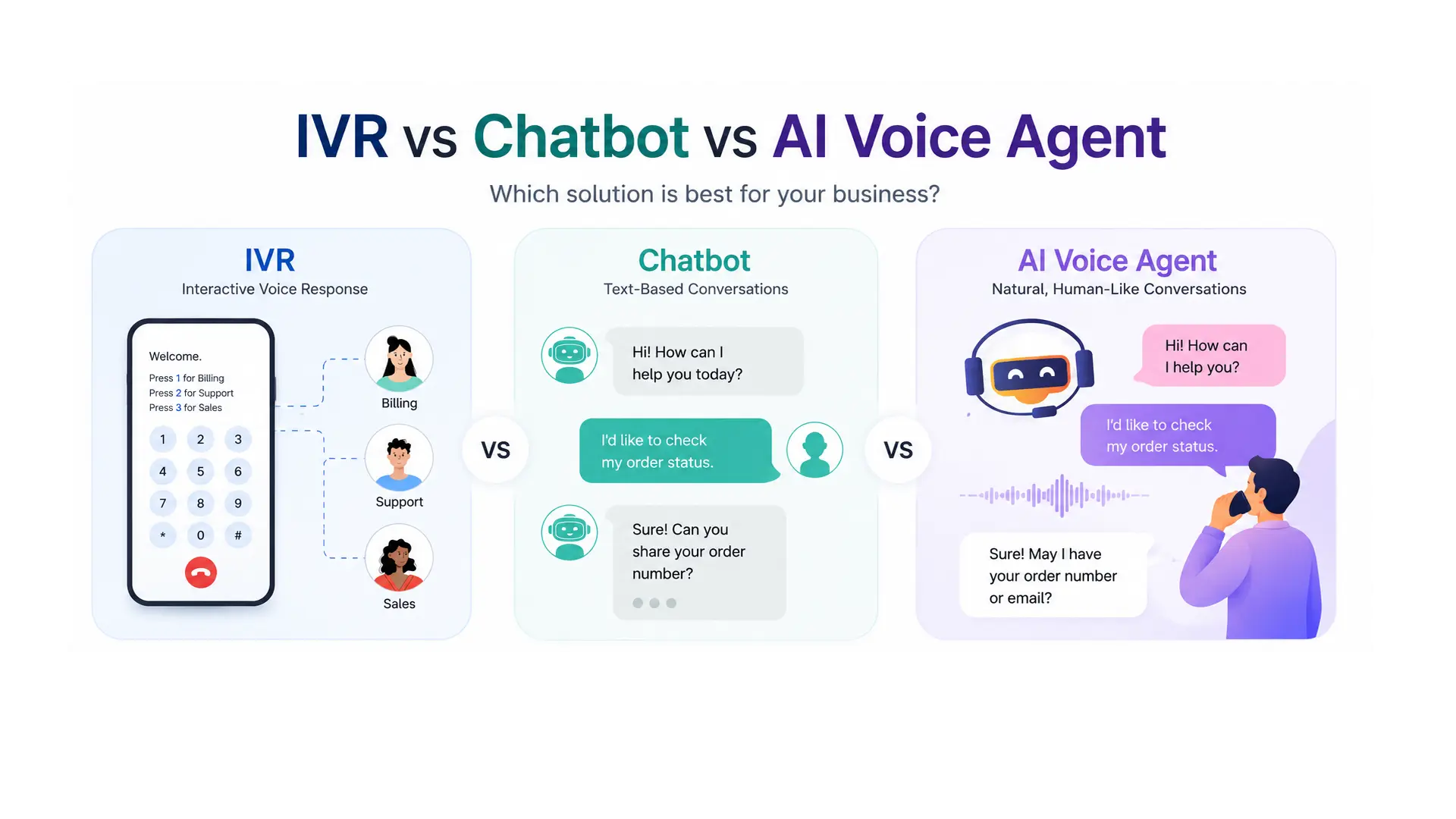
Interactive Voice Response systems route callers through a fixed menu of numbered options, spoken or keyed in. IVR is cheap and reliable for predictable, high-volume routing, but it forces the caller to fit their problem into the menu, and anything outside that structure usually ends in a transfer, often after a long wait.
Chatbots: Text First, Asynchronous Support
Chatbots handle written conversations on a website, app, or platform like WhatsApp, and are strong for FAQs and order status checks that customers can pick up again later. They struggle with longer, multi-turn issues, and cannot help anyone who simply prefers to talk rather than type.
AI Voice Agents: Natural Conversation at Call Volume
AI voice agents combine speech recognition, large language models, and voice synthesis to hold a real spoken conversation rather than presenting a menu. A caller can explain their issue in their own words and get a response in context, with the Singapore AI voice agent requiring no menu to navigate and no need to switch to typing.
How They Compare : IVR, Chatbot, AI Voice Agent
| Factor | IVR | Chatbot | AI Voice Agent |
|---|---|---|---|
| Interaction style | Menu selection, keypad or spoken | Typed, text based | Natural spoken conversation |
| Best suited for | Simple, predictable routing and transactions | FAQs and async, text native queries | Complex, conversational, or urgent enquiries |
| Typical containment | Moderate for routine tasks, drops sharply outside the menu | Strong for FAQs, weaker on multi-turn issues | Strong across both simple and moderately complex calls |
| Availability | 24/7 | 24/7 | 24/7 |
| Cost per interaction | Lowest | Low | Moderate, but often lower than a human call once scaled |
Why the Choice Matters More in Singapore
Singapore adds a few local factors that make this decision less generic than it looks. The customer base is genuinely multilingual, moving between English, Mandarin, Malay, and Tamil, sometimes within the same call, and a system trained mainly on standard English struggles to keep up. Many Singaporean customers also still prefer a phone call over a chat window for anything they consider important, such as a billing dispute or an urgent delivery issue, which limits how far a chatbot alone can take a customer service strategy here.
The direction of travel also matters. Zendesk's CX Trends 2026 report, based on a global survey that included Singapore, found that 83 percent of CX leaders now believe voice AI has reached the point where it can meaningfully change the customer experience, and 85 percent say customers will drop a brand that cannot resolve their issue on first contact. That combination, rising confidence in voice AI and shrinking patience for unresolved calls, is exactly the gap IVR and chatbots alone tend to leave open.
When IVR Still Earns Its Place
IVR remains a sensible choice for high volume, highly predictable routing where the menu genuinely matches what customers are calling about, such as directing calls between departments or handling simple account verification before a transfer. It is inexpensive to run and easy to maintain, and for businesses with a narrow, well understood range of call reasons, it can still contain a meaningful share of calls without any conversation at all. The weakness is that it does not scale to anything unpredictable, and a menu built for last year's call reasons quickly becomes a source of frustration rather than efficiency.
When a Chatbot Is the Better Fit
A chatbot is usually the right tool when the audience is already on a digital channel, the queries are genuinely FAQ shaped, and the interaction does not need to happen in real time. Order status checks, account questions, and policy lookups are all well suited to a chatbot, particularly on a website or WhatsApp where customers already expect to type rather than talk. Chatbots are also the cheapest option to run at scale, which makes them a good fit for high volume, low complexity support where speed of typing matters less than availability.
When an AI Voice Agent Wins
An AI voice agent for customer service tends to win when the enquiry is more complex than a single FAQ, when the customer would rather explain their situation than click through options, or when speed of resolution genuinely matters, such as a delivery issue, a service outage, or a billing dispute. It is also the only one of the three that keeps working for customers who default to picking up the phone rather than opening an app, which in Singapore is still a meaningful share of any customer base, particularly for anything the customer considers urgent or high stakes. Because it can carry context across a conversation and hand off cleanly to a human when needed, it tends to produce a noticeably better experience than a menu or a text bot for anything beyond the simplest queries.
The Hybrid Model Most Singapore Businesses Are Landing On
In practice, very few Singapore businesses replace one channel entirely with another. The more common pattern is a layered setup: a lightweight IVR for the small number of calls that genuinely are simple routing decisions, and one platform handling everything else, chat, WhatsApp, and AI voice agent conversations together, with clean escalation to a human agent when a case is too sensitive or complex to resolve automatically. This is the model OpenGreet is built around, voice, chat, and WhatsApp on one platform, with IVR being the one piece it deliberately leaves to whatever system you already have in place for basic routing.

Questions to Ask Before You Decide
- Do most of our customer queries follow a small, predictable set of paths, or do they vary widely from call to call?
- Are our customers comfortable typing out their issue, or do they expect to speak to someone, especially for anything urgent?
- How many of our calls need multilingual support across English, Mandarin, Malay, or Tamil?
- What share of our current call volume ends up escalated to a human regardless of the system in place, and why?
- Do we have a clear escalation path for cases that genuinely need a person, whichever channel the customer starts on?
The answers usually point towards a mix rather than a single winner, but for most Singapore businesses handling any meaningful volume of phone enquiries, an AI voice agent is what closes the gap that IVR and chatbots leave behind.
Final Thoughts
IVR, chatbots, and AI voice agents solve different problems, and the businesses getting the best results in Singapore are generally the ones using each for what it is actually good at rather than forcing every enquiry through one channel. If your customers are moving between typing and calling, and phone volume is where a human team or an old IVR is struggling to keep up, that gap is exactly what OpenGreet is built to close, with chat, WhatsApp, and AI voice agents running on one platform.