
Key Takeaways
How many more meetings can AI actually add?
At the calculator's default settings, 2x call volume and a 65 percent AI call-to-meeting rate, the worked example shows about 65 percent more meetings booked compared to the human team alone.
Does AI replace my sales team?
No. AI adds call volume on top of what your team already does, it doesn't replace them.
What numbers do I need to work this out for my own business?
Connect rate, booking rate, win rate, and average deal value.
Is more cold calling still legal in Singapore?
Yes, as long as it follows PDPA and the Do Not Call Registry, regardless of who or what is making the calls.
Are the calculator's default assumptions realistic?
They're intentionally conservative, a 2x call volume increase and a 65 percent AI conversion rate, so actual results could turn out higher.
Where can I run my own numbers?
Use OpenGreet's Sales ROI Calculator to plug in your own connect rate, booking rate, and deal value.
Watch: How AI Cold Calling Gets You More Meetings
Cold calling still works in Singapore. The problem isn't that customers don't want to take a sales call, it's that a human team can only make so many calls in a day. If you've ever wondered how many more meetings, how much more pipeline, and how much more revenue your team could generate by adding AI, here's the actual maths that explains it.
The Real Limit Isn't Interest, It's Capacity
A Singapore sales team's cold calling output is limited by how many people you have and how many hours they can work, not by whether the prospects are worth calling. AI-powered sales calls don't replace your team, they add more call volume on top of what your team already does. That's why the real question isn't "should AI replace my reps," it's "how many more calls, and therefore how many more meetings, could we make if we weren't limited by capacity."
More Calls Only Help If They're Done Properly
Singapore cold calling still has to follow the rules. It needs to work within PDPA and the Do Not Call Registry, no matter how many calls are being made or who is making them. We've explained what that means in our cold calling and telemarketing guide for Singapore, worth reading before you scale up your call volume.
Three Numbers Everything Is Based On
- Connect rate: the percentage of calls that actually reach a decision maker, not voicemail or no answer.
- Booking rate: the percentage of those connected calls that turn into booked meetings.
- Win rate: the percentage of booked meetings that actually close as a deal.
How These Numbers Work in Practice
More Meetings Booked
This is calculated by taking the number of additional AI calls, multiplying by your connect rate, then multiplying by your booking rate, adjusted for how well AI turns calls into meetings. AI is great for making lots of calls quickly, but human reps often do a slightly better job of turning connected calls into meetings because of personal rapport, that's why the model uses an adjusted booking rate rather than the same one as your team.
Revenue Opportunity
This is calculated by multiplying the number of additional meetings by your win rate and average deal value. This gives a projection of potential revenue, not a net return on investment, it doesn't include platform costs, setup, or margins, so treat it as potential extra revenue to compare with your actual costs, not as guaranteed profit.
More Pipeline
This is the total value of all additional meetings before applying the win rate. It's a useful number by itself, since sales leaders often track pipeline and closed revenue separately.
Staff Time Saved by AI
Since AI adds more calls rather than replacing existing ones, it doesn't actually free up staff time. Instead, this number shows the value of gaining more outreach capacity without hiring more people, it's the cost in staff time that would be needed to make that same number of additional calls yourself.
AI vs Your Team: What's the Same, What's Different
It's important to understand that this is a modelling assumption, not a real-world fact. For simplicity, the calculator assumes the same connect rate applies to additional AI calls as it does to your team's calls. Where it differs is in the booking rate, AI is assumed to convert a connected call into a meeting at a lower rate than a human rep, based on the AI call-to-meeting effectiveness slider. This is a realistic, cautious assumption, not a sales pitch, even though AI can make far more connected calls, human reps can still outperform AI when it comes to closing meetings. You can adjust the slider to test different scenarios against your own numbers.
A Worked Example
Imagine a sales team in Singapore with four members, each making about 10 calls a day. Together, they make around 40 calls a day, which adds up to about 10,000 calls a year, assuming 250 working days. At a 15 percent connect rate and a 15 percent booking rate, they end up booking around 225 meetings a year. Of those, 25 percent turn into sales, averaging $5,000 each, resulting in about $281,250 in revenue.
When you add AI to the mix, it increases the number of calls by 2 times, making an additional 10,000 calls a year. AI doesn't just make more calls, it also converts them into meetings, doing so at 65 percent of the human team's rate, which works out to converting connected calls into meetings at 9.75 percent.
| Metric | Human Team Only | Additional from AI |
|---|---|---|
| Annual calls | 10,000 | +10,000 |
| Connects (15%) | 1,500 | +1,500 |
| Meetings booked | 225 | +146.25 |
| Deals closed | 56.25 | +36.56 |
| Revenue | $281,250 | +$182,813 |
The 146.25 extra meetings added by AI, against the team's own 225, works out to a 65 percent increase. These numbers are just an example based on the calculator's default settings, your actual numbers, like connect rate, booking rate, and deal value, will affect the outcome, which is why it's important to run your own figures instead of relying on a general example.
Why the Defaults Are Conservative
The calculator starts with a 2x call volume increase and a 65 percent AI call-to-meeting rate. These numbers are on the lower side of what is attainable, and that's intentional. It's better to have a realistic projection you can surpass than one that looks great on paper but doesn't deliver. You can adjust all the inputs, so the numbers that matter most to your business are up to you, not us.
Don't Have These Numbers Yet?
Most sales teams don't keep track of their connect rate, booking rate, and win rate in their heads, and that's okay, having a rough idea is still much better than skipping the exercise. If you use a CRM, you can usually find these numbers in your call logs or pipeline stages. If you don't have historical data, just track a week of calls manually, that should give you a good starting point, and you can always come back to refine the numbers once you have more data.
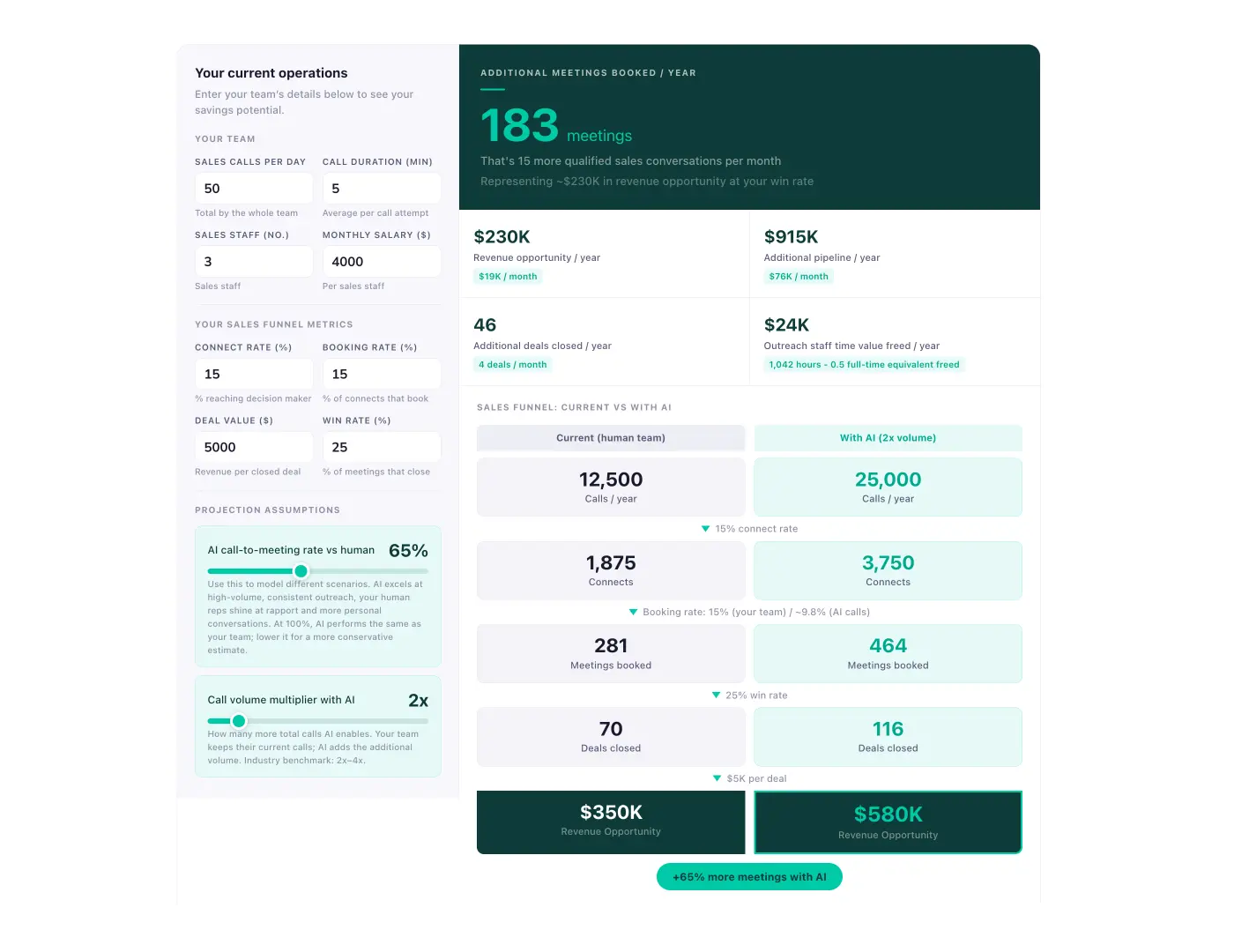
Run Your Own Numbers
The maths we've gone through is only helpful once you apply it to your own team's size, call volume, and funnel rates. You can use the Sales ROI Calculator to plug in your own numbers and see how many more meetings, pipeline, and revenue opportunity you might get, giving you a clear picture of the potential impact for your team in just a few minutes.
Final Thoughts
Cold calling in Singapore isn't broken, it's just limited by the number of calls your team can make. Once you can see the actual difference between what your team is doing now and what could be achieved with more calls, the decision becomes a lot clearer than just thinking "AI might help." If you want to see how an AI voice agent would fit into your specific business process, that's worth a proper conversation rather than a generic estimate.