Key Takeaways
What is an AI voice agent?
Software that holds a real spoken phone conversation using speech recognition, a language model, and voice synthesis together. No menu, no script.
Is an AI voice agent the same as an AI call agent?
Yes. Different name, same underlying technology.
How does AI calling actually work?
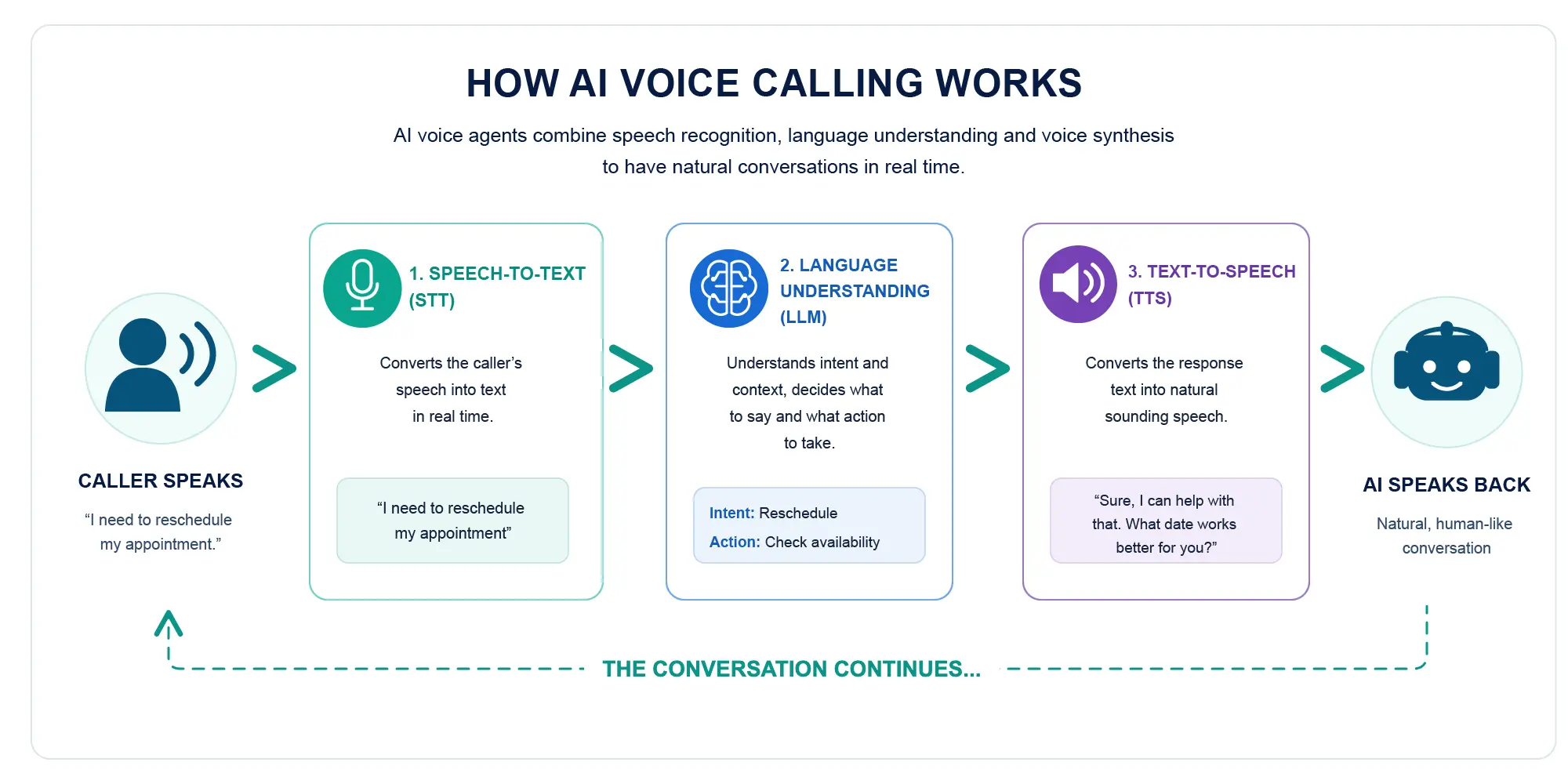
Speech is converted to text, a language model works out intent and generates a response, then that response is converted back to natural sounding speech, fast enough that it doesn't feel like a delay.
Can an AI voice agent replace human staff?
No. It handles the repetitive, predictable calls. Humans still handle complaints, negotiations, and anything needing real judgement.
What can AI voice agents actually automate?
Sales calls, appointment booking, payment reminders, re-engagement, customer service, and feedback calls, both outbound and inbound.
Why are Singapore businesses adopting AI calling?
Multilingual customers, PDPA and DNC Registry compliance needs, and grant support through schemes like EDG and NTUC CTC.
Is an AI voice agent right for my business?
If call volume is high, customers expect after-hours support, or your team is stretched thin on repetitive calls, it's worth evaluating.
If you have called a business recently and found yourself talking to something that understood you properly, asked a sensible follow up question, and never once said "press 1 for sales," you were probably speaking to an AI call agent rather than a person or a traditional phone system. AI voice agents have moved quickly from a novelty to a genuine part of how Singapore businesses handle sales calls, customer service, appointment bookings, and reminders. This guide covers what an AI voice agent actually is, how AI calling works under the hood, and where it fits for a Singapore business specifically.
What Is an AI Voice Agent?
An AI voice agent is software that can hold a real, spoken phone conversation with a customer, understanding what they say and responding naturally, rather than routing them through a fixed menu or a scripted chatbot flow. It can make outbound calls, such as a sales follow up or a payment reminder, or handle inbound calls, such as a customer asking about their order. Unlike a traditional IVR, there is nothing for the caller to navigate. They simply talk, the same way they would to a person. You may also see the same technology called an AI call agent or an AI phone agent. These generally describe the same underlying system rather than different products, the terminology just varies depending on who is using it.
How Does AI Calling Actually Work?
AI calling combines three technologies working together in real time. Speech recognition converts what the caller is saying into text as they speak. A language model interprets what they actually mean, including context from earlier in the same call, and works out what to say back. Voice synthesis then turns that response into natural sounding speech. All of this needs to happen with almost no delay, since a pause that feels normal in a text chat feels awkward and robotic on a phone call. In practice, callers start noticing the gap once latency creeps past around a second, which is why production systems spend as much effort shaving down delay as they do improving the quality of the language itself.
The result, when it works well, is an AI call where the caller can say something like "I need to reschedule my appointment to next Tuesday" and get handled correctly in one go, rather than having to repeat themselves through a menu tree.
What Can an AI Voice Agent Actually Understand?
Modern AI voice agents handle considerably more than fixed keywords. In practice, that generally includes interruptions and corrections mid-sentence, such as a caller saying "actually, make that next Friday instead," incomplete or informal phrasing rather than a full grammatically correct sentence, and follow up questions that build on what was already said earlier in the same call without the caller needing to repeat themselves. Voice agents built for this region are also trained on local accents, such as Singapore English, Singlish, and Mandarin, rather than a single standard English model, which matters considerably more here than it does in markets with a more uniform accent. This is the practical difference between a system genuinely having a conversation and one just matching phrases against a script.
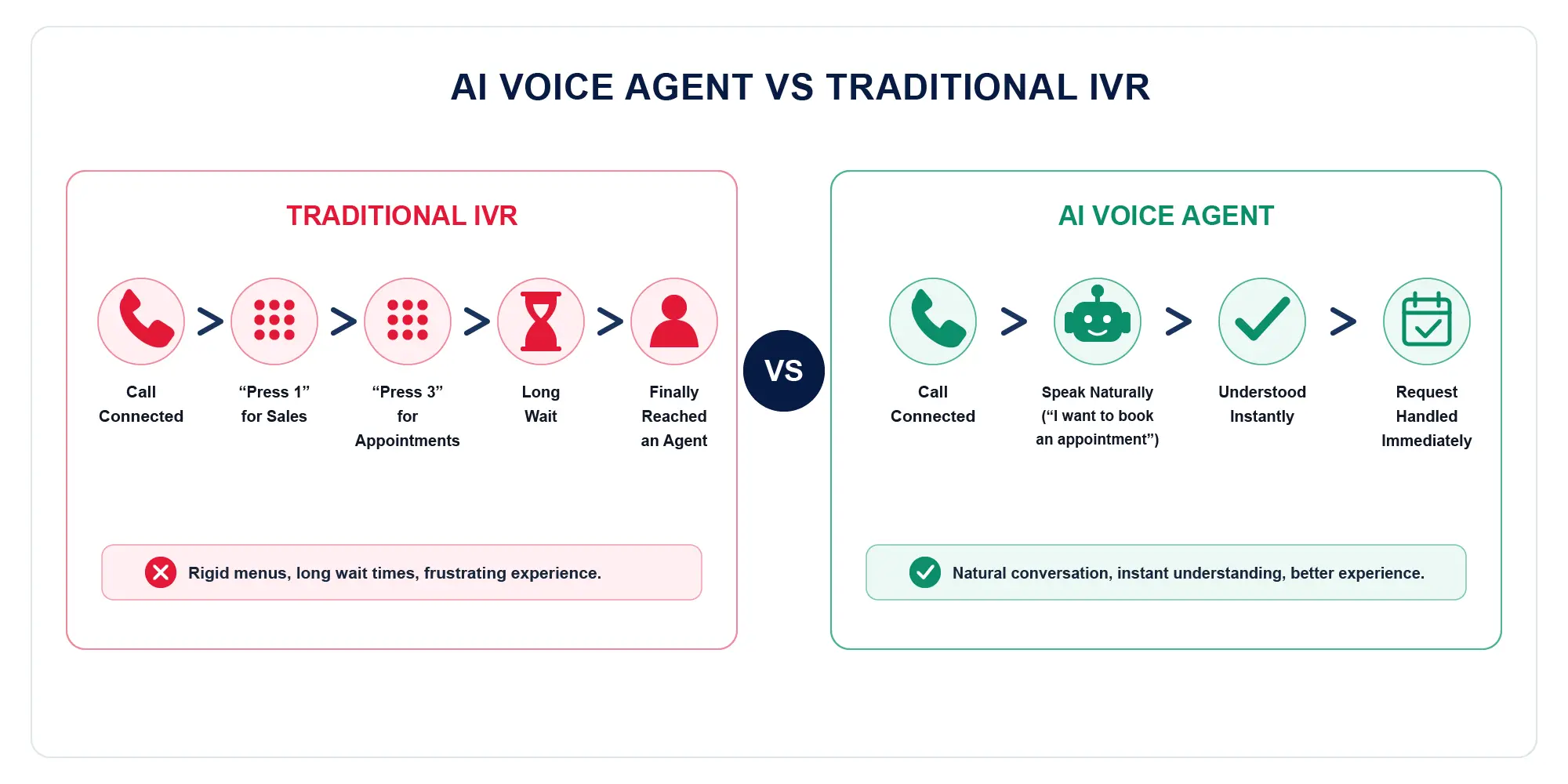
How Is This Different from IVR or a Chatbot?
IVR routes callers through numbered menu options and cannot handle anything outside that script. Chatbots handle typed conversations well but are limited to text based channels and struggle with longer, more complex exchanges. An AI voice agent is built specifically for spoken, real time conversation, which makes it the option for anything that needs to happen over the phone. We covered this comparison in full detail, including when each option actually makes sense, in AI Voice Agent vs Chatbot vs IVR: Which Is Best for Customer Service in Singapore.
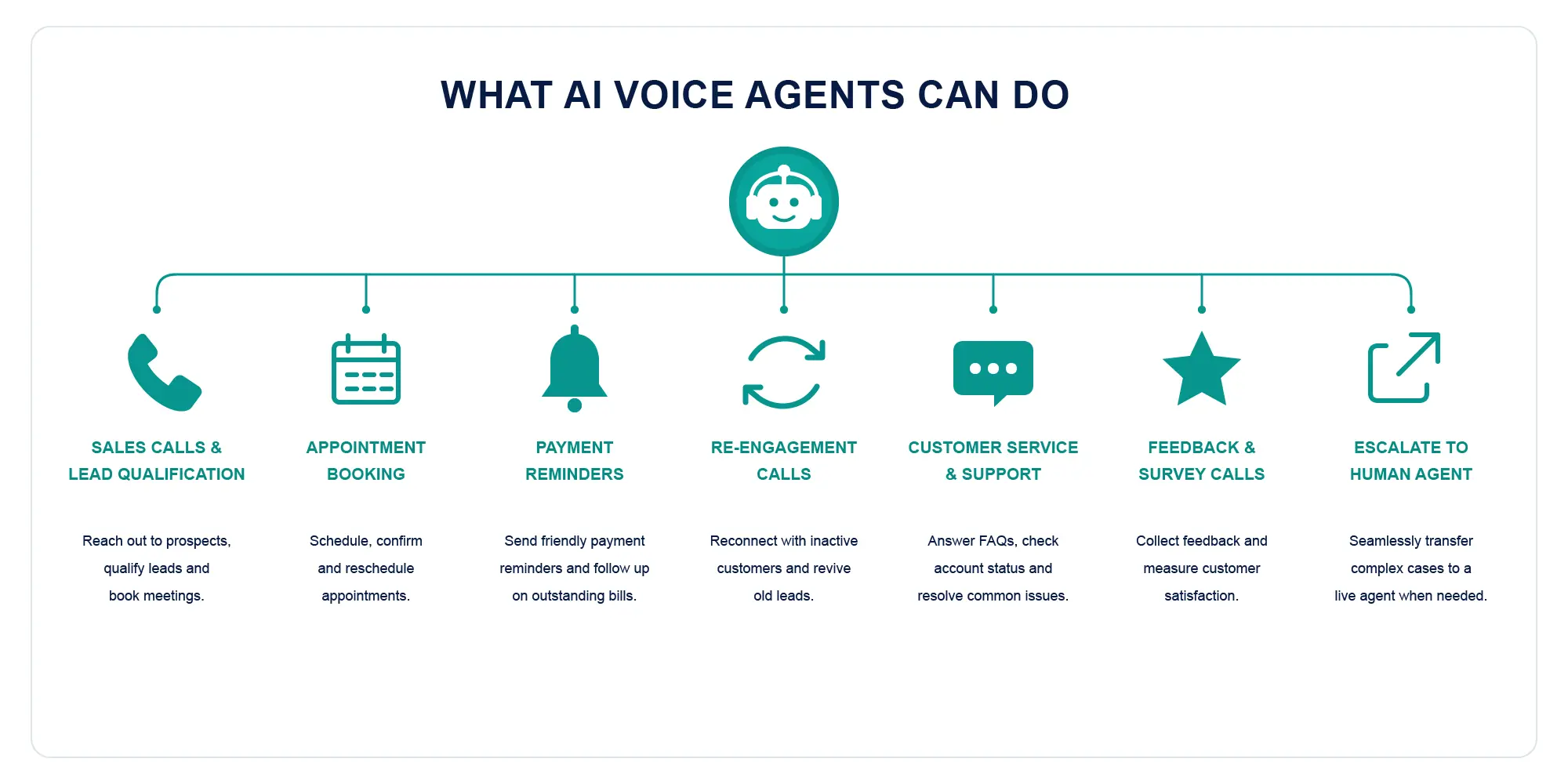
What Can You Actually Automate with AI Calling?
AI voice agents generally split into two directions, outbound AI calls the business initiates, and inbound AI calls the business receives.
Outbound AI Calling
This covers sales calls and lead qualification, appointment booking and confirmation, payment reminders, re-engaging customers who have gone quiet, and post purchase feedback and survey calls. These are generally structured, repeatable conversations, which makes them well suited to automation without losing the personal feel of a phone call.
Inbound AI Calling
This covers customer service and support enquiries, answering common questions, checking order or account status, and escalating to a human when a case genuinely needs one. The goal here is not to replace every human conversation, but to handle the high volume, predictable share of calls so your team can spend their time on the ones that need judgement.
Which Industries Use AI Voice Agents?
AI voice agents are being adopted across a wide range of industries, including healthcare for patient reminders and enquiry handling, real estate for viewing bookings and lead follow up, financial services for account enquiries, education, hospitality for bookings and guest requests, e-commerce and retail for order and delivery enquiries, and telecommunications. The common thread is not the industry itself, but having a meaningful volume of structured, repeatable phone conversations somewhere in the business.
Can an AI Voice Agent Replace Your Team?
Not entirely, and that is not really the goal. AI voice agents are built to take on the repetitive, predictable share of calls, the ones that do not need judgement or negotiation, so your team's time goes toward the conversations that genuinely need a person. The businesses getting the most value tend to run a hybrid model, AI handling the volume, a human handling the exceptions.
That also means knowing where an AI voice agent is a poorer fit matters just as much as knowing where it excels. It handles structured, repeatable conversations well: booking and confirming appointments, sending reminders, answering common questions, and qualifying leads. It is a weaker fit for anything that genuinely needs human judgement, such as legal or financial advice, a customer who is upset and needs to be heard rather than processed efficiently, or a complex negotiation with several moving parts. Being upfront about that distinction is part of implementing this well, rather than trying to automate every single call regardless of what it actually needs.
Why Singapore Businesses Are Adopting AI Calling
A few things make this particularly relevant for the Singapore market specifically. Customers here regularly move between English, Mandarin, sometimes within the same call, so a Singapore-ready AI voice agent needs to be built for that reality rather than trained on standard English alone. Businesses handling personal data over the phone also need to operate within the PDPA, including checking numbers against the Do Not Call Registry before making marketing calls, which is worth building into how any calling system, AI or otherwise, is set up from the start rather than retrofitted later.
There is also direct government support for adoption here. Singapore businesses can potentially fund part of the investment through schemes like the Enterprise Development Grant, which can support up to 50 percent of eligible business transformation costs, and the NTUC Company Training Committee grant, which can support up to 70 percent for workforce and productivity transformation projects, subject to eligibility.
Cost is usually the next question once the compliance and language pieces make sense, and it is worth comparing properly rather than assuming. We broke that down directly in AI Voice Agents vs Human Sales Teams: A Cost Comparison for Singapore Businesses.
Is an AI Voice Agent Right for Your Business?
It tends to make the most sense when call volume is high enough that staff time is genuinely being spent on repetitive, predictable conversations, when customers expect a response outside of standard office hours, or when an existing IVR or overstretched team is visibly struggling to keep up. If any of that sounds familiar, we broke down the specific warning signs in 7 Signs Your Singapore Business Has Outgrown IVR.
Final Thoughts
Whether you call it an AI voice agent, an AI call agent, or just AI calling, it is not replacing every phone conversation your business has. It is replacing the repetitive ones that quietly consume your team's time every day, the reminders, the routine questions, the bookings. If your business still leans on IVR, voicemail, or manual follow up calls to handle that volume, this is a reasonable moment to check whether a real conversation would serve your customers better.